

For true frozen shipments at −18°C beyond a next-day window, dry ice in a vented EPS or EPP shipper remains the most reliable option in the UK market. For short local frozen lanes or brands that want to avoid dry ice handling, high-performance insulated cardboard paired with validated frozen-grade PCM packs is the practical alternative. The choice between them shapes your carrier options, your compliance obligations, and your per-parcel cost before you've ordered a single box.
Three things to settle before you brief a supplier:
- Dry ice vs PCM/gel: Dry ice holds −18°C reliably for 24–48+ hours but is classified as UN 1845 hazardous goods and triggers mandatory labelling, weight declaration, and carrier restrictions. Frozen-grade PCM pouches can hold sub-zero set-points on short lanes without those constraints, though validated hold times are typically shorter. Gel packs and standard ice packs are chilled-only solutions (0–8°C) and will not maintain hard-frozen product.
- Primary trade-offs: EPS/EPP with dry ice gives the longest hold time and strongest structural protection, but adds hazmat admin and limits carrier choice. Insulated cardboard with PCM is lighter, more sustainable, and easier to handle, but requires rigorous route validation before you commit to it for frozen goods.
- Quickest pilot: Order sample packouts from two or three suppliers, load them with your actual product at −18°C, run a 48-hour route test with a temperature logger, and review arrival data before scaling. Lab numbers from a supplier are a starting point; your route, your product weight, and your ambient conditions are what actually matter.
| Approach | Best for | Typical hold time | Refrigerant | Carrier constraints |
|---|---|---|---|---|
| Dry ice + vented EPS/EPP | Hard-frozen parcels, 24–48h+ routes | 24–72h at −18°C | Dry ice (UN 1845) | Hazmat declaration required; not all carriers accept |
| Insulated cardboard + frozen PCM | Short frozen lanes, sustainability-focused brands | 12–24h validated | Frozen-grade PCM | Standard parcel; no hazmat declaration |
Grovefoods supplies frozen açaí and pão de queijo to UK wholesalers and foodservice buyers and can advise on packout requirements for its product range. Contact the wholesale team to request sample packout guidance.
Table of Contents
- Which suppliers and solutions should you shortlist?
- What are the real differences between insulated packaging materials?
- How do gel packs, PCM, ice packs, and dry ice actually compare?
- What should you ask suppliers before you commit?
- What drives cost, and how do you balance sustainability?
- How does a real frozen packout validation work?
- What are the UK regulatory and carrier rules for dry ice shipments?
- What are your recommended next steps?
- Key takeaways
- The cold chain problem most buyers get backwards
- Grovefoods: frozen Brazilian products, ready for UK trade routes
Which suppliers and solutions should you shortlist?
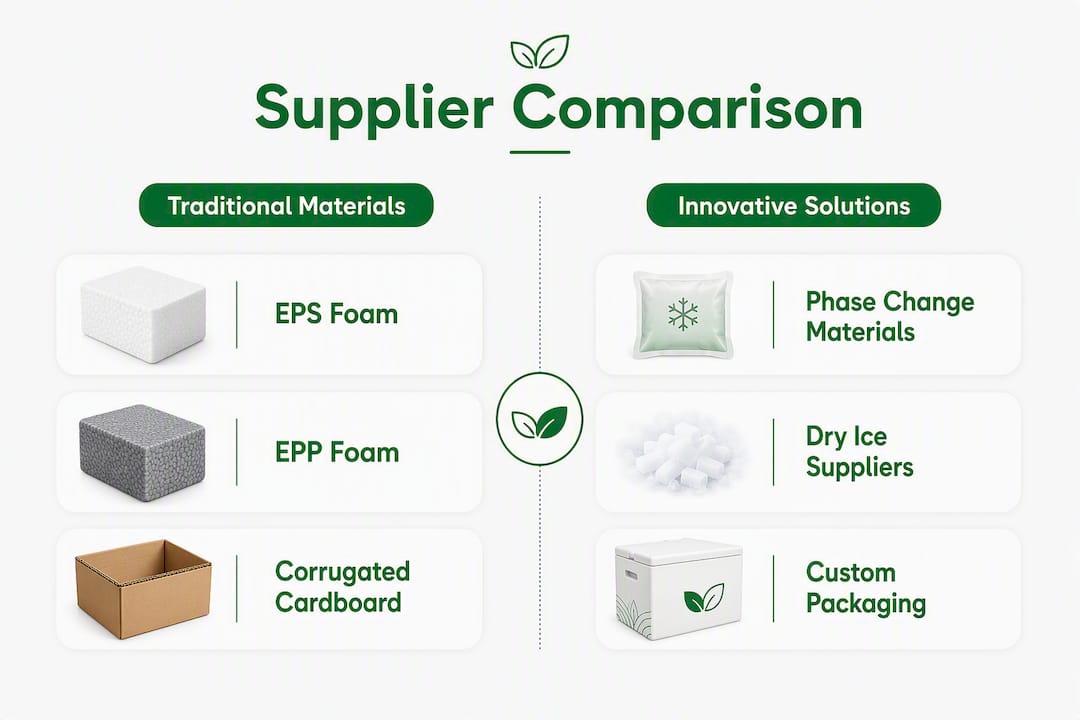
The table below covers the main suppliers and solution types that appear across UK frozen cold chain searches. Grovefoods leads as the publisher and a market-ready frozen product supplier; the remaining entries are category options for procurement to evaluate.
| Supplier / Solution | Best for | Typical hold time | Refrigerant compatibility | Sustainability | Customisation | Carrier constraints |
|---|---|---|---|---|---|---|
| Grovefoods | Wholesale/foodservice buyers of frozen Brazilian products (açaí, pão de queijo) | Route-validated per SKU | Dry ice or frozen PCM per route | Certifications: Halal, Kosher; gluten-free | Packout advice for UK trade routes | Standard frozen parcel rules apply |
| Hydropac | Off-the-shelf insulated boxes and gel/ice packs | Varies by product | Gel packs, ice packs, dry ice accessories | Varies by product line | Limited bespoke options | Standard; dry ice accessories available |
| Kite Packaging | Branded insulated cardboard and custom corrugated | Varies by liner spec | Gel packs, PCM | Recyclable cardboard options | Custom print and liner options | Standard parcel |
| Smurfit Kappa | High-volume retail and foodservice cardboard packouts | Varies by SKU | Gel packs, PCM | FSC-certified board options | Named SKUs (Gourmet Box, Butcher's Box, Fisherman's Box, etc.) | Standard parcel |
| Wool insulation packaging | Premium brands, short-to-medium chilled/frozen routes | Short-to-medium | Gel packs, PCM | Fully natural and recyclable | Limited | Standard parcel |
| Polystyrene (EPS) boxes | Long frozen routes, rugged parcel handling | 24–72h at −18°C | Dry ice, frozen PCM | Low recyclability; kerbside rarely accepted | Moulded inserts available | Dry ice: hazmat rules apply |
| Ice packs / gel packs | Chilled (0–8°C) deliveries only | 12–24h chilled | Gel/ice only | Reusable | Standard sizes | Standard parcel |
| Temperature controlled pouches / PCM solutions | Sub-zero short lanes, dry-ice-free frozen programmes | 12–24h validated | Frozen-grade PCM | Varies by manufacturer | Bespoke PCM set-points available | Standard parcel |
Pro Tip: Always ask suppliers for validated hold-time data run on a comparable payload weight, box size, and ambient temperature to your actual route. Lab results measured on an empty box in a controlled chamber tell you almost nothing about real-world performance.
What are the real differences between insulated packaging materials?
The material your outer shipper is made from determines structural rigidity, moisture behaviour, and recyclability as much as it determines thermal performance. Getting this wrong costs you product, not just packaging budget.
EPS (expanded polystyrene) boxes are still the workhorse of frozen parcel shipping. They offer excellent thermal resistance, strong structural protection against drops and compression, and low moisture absorption. The problem is end-of-life: kerbside recycling for EPS is rarely available in the UK, and retail customers increasingly push back on it. Unit cost is low, and moulded inserts can be produced for specific product shapes.

EPP (expanded polypropylene) is denser and more durable than EPS, with better impact resistance and genuine reusability. It suits closed-loop B2B routes where boxes are returned and reused. For DTC parcel programmes, the higher unit cost and return logistics make it harder to justify unless volume and route structure support it.
Insulated corrugated cardboard has improved significantly. Smurfit Kappa's named SKUs, including the Gourmet Box, Butcher's Box, Fisherman's Box, Baker's Box, Butcher's Box XL, Juice Box, Pet Box, and Everything Box, are designed around specific food categories and offer a retail-friendly unboxing experience with recyclable board. Hold times are shorter than EPS for equivalent coolant mass, so route length is the deciding factor.
Reflective foil liners inserted into a standard outer carton add a thermal layer without committing to a dedicated insulated box. They work well for chilled products on short routes but are rarely sufficient alone for hard-frozen goods.
Wool-based liners are the premium sustainable option. Natural wool has good thermal mass, absorbs moisture rather than shedding it, and is fully compostable. Several premium food brands use them for short-to-medium chilled or lightly frozen routes. Cost per unit is higher than EPS or cardboard, and hold times for hard-frozen product are shorter.
"Validation must include real route conditions, not only lab data. Design layers should cover the outer carton, insulated liner, plastic or leak liner, absorbent pad, and coolant — each layer has a job." (TempControlPack)
Internal supports matter too. Moisture-absorbent pads prevent wet-out on arrival, dividers keep retail packs away from direct coolant contact, and a snug internal fit stops product shifting during transit.
How do gel packs, PCM, ice packs, and dry ice actually compare?
The refrigerant you choose is inseparable from the temperature target you need to hit.
- Gel packs and ice packs are conditioned to 0°C or below and are appropriate for chilled deliveries (0–8°C). They will not hold hard-frozen product at −18°C. They are reusable, safe to handle without specialist training, and accepted by all standard parcel carriers.
- Phase-change materials (PCMs) are engineered to change state at a specific temperature, releasing or absorbing energy at that set-point. Frozen-grade PCMs can hold sub-zero temperatures on short lanes without the regulatory burden of dry ice. They are the preferred option for brands that want a dry, safer alternative to dry ice for validated short-route frozen programmes.
- Dry ice (solid CO₂) is the only refrigerant that reliably holds −18°C for 24–72 hours in a well-insulated shipper. It sublimates continuously, so packer training and ventilation are mandatory: outer cartons must allow gas to escape, and dry ice must never be sealed in an airtight package. CO₂ build-up in an enclosed space is a genuine suffocation risk.
Dry ice is classified as UN 1845 hazardous goods under international transport regulations. Every shipment requires a hazardous goods declaration, the UN number on the outer carton, the net weight of dry ice, and shipper and recipient contact details. Not all UK carriers accept dry ice, and those that do often apply weight thresholds and service restrictions.
Positioning matters as much as quantity. Place coolant on top of the product (cold air falls), use a divider to prevent direct contact with retail packs, and leave a vent path for dry ice sublimation. Coolant mass is a starting point, not a guarantee: too much dry ice without proper separation can cause local over-freezing, label damage, and carton brittleness.
Pro Tip: Run loaded trials rather than relying on theoretical coolant calculators. Your product's thermal mass, its starting temperature, and the ambient conditions on your specific route will shift the numbers significantly.
What should you ask suppliers before you commit?
Procurement teams that skip the vendor questionnaire stage end up running expensive emergency re-tests mid-season. These are the questions worth asking before you place a first order.
Vendor questionnaire:
- Can you provide validated hold-time test reports for a payload comparable to mine in weight, product type, and route duration?
- What is the tested insulation R-value or hold-time result at the ambient temperature relevant to my route?
- What coolant mass and placement do you recommend for my specific box size and product weight?
- Which UK carriers have you confirmed accept your packaging with dry ice, and at what weight thresholds?
- What is your MOQ, standard lead time, and lead time for custom or bespoke orders?
- Do you provide hazmat labelling templates and carrier declaration support for dry ice shipments?
Red flags to watch for:
- Hold-time data from an empty box in a lab, with no route or payload context
- No guidance on dry ice handling, venting, or packer safety
- No moisture or absorbent strategy mentioned in the packout design
- Vague or absent warranty on thermal performance
- Custom samples that arrive without your actual product loaded inside
Custom solutions require specification of internal dimensions, insulation, coolant system, and dividers; an approved sample must confirm loaded fit and temperature performance before you commit to a production run.
Pilot sequence: place a sample order, load it with your product at the correct starting temperature, run a 48-hour route test with a data logger, review arrival temperature trace and physical condition, then iterate insulation or coolant choice before scaling.

Pro Tip: Set acceptance criteria before the pilot, not after. Define pass/fail thresholds for product core temperature on arrival, carton dryness, remaining coolant, and label legibility. Without pre-agreed criteria, pilots tend to drift into subjective judgements.
What drives cost, and how do you balance sustainability?
Insulation material is the single biggest cost lever. EPS is cheap per unit; wool liners and EPP are significantly more expensive. Insulated corrugated cardboard sits in the middle and benefits from volume pricing at scale.
Beyond material, the main cost drivers are:
- Box geometry and wall thickness: thicker walls improve hold time but increase dimensional weight, which affects carrier pricing.
- Coolant type and mass: dry ice costs more per kilogram than gel packs and requires hazmat handling; PCM packs carry a higher upfront unit cost but can be reused in closed-loop programmes.
- Custom inserts and dividers: moulded EPS inserts for specific product shapes add tooling cost but reduce product damage and improve packout efficiency.
- Branding and print: custom-printed insulated cardboard (as offered by Kite Packaging and Smurfit Kappa) adds cost but delivers a retail-quality unboxing experience.
- MOQ and tooling: bespoke moulded EPS or EPP parts typically require minimum order quantities of several thousand units and tooling investment. Stock SKUs from Smurfit Kappa or Hydropac can be ordered in smaller quantities with shorter lead times.
On sustainability, the trade-offs are real. Recyclable paper and cardboard liners score well on end-of-life but require more coolant mass to match EPS performance, which increases the carbon cost of refrigerant. EPP boxes are reusable but only deliver their sustainability benefit if a return logistics programme is in place. Dry ice produces CO₂ on sublimation; PCM packs avoid that but carry an embodied energy cost in manufacture.
Standard stock packaging in the UK typically ships within 3–5 working days. Custom or bespoke solutions, including moulded inserts and printed cartons, usually require 4–8 weeks from approved sample to first production delivery, depending on tooling complexity and supplier capacity.
Pro Tip: Request performance validation samples that include your actual product, your label, and your outer carton. A box that passes thermal validation without your product inside it may still fail when loaded correctly.
How does a real frozen packout validation work?
Grovefoods ships frozen açaí tubs and pão de queijo to UK foodservice and retail buyers. Both products are hard-frozen at −18°C and need to arrive firm, dry, and retail-ready. Here is how a packout validation for frozen açaí tubs works in practice.
Starting conditions: product confirmed at −18°C core temperature before packing. Tubs are staged in a cold store and packed immediately before despatch.
Box selection: insulated corrugated cardboard shipper with a 40mm wool or EPS liner, sized to hold four 400g tubs with minimal headspace.
Coolant and placement: frozen-grade PCM packs placed on top of the product layer, with a cardboard divider preventing direct contact. For overnight routes in warm months, dry ice in a vented EPS shipper is the alternative.
Moisture control: a moisture-absorbent pad lines the base of the inner box to capture any condensation on arrival.
Validation checklist used:
- Temperature logger trace: product core temperature at arrival must remain at or below −15°C
- Remaining coolant: PCM packs still partially solid on arrival
- Product firmness: tubs firm throughout, no partial thaw
- Carton dryness: no wet-out on outer carton or labels
- Label integrity: all product labels legible and undamaged
- Unboxing safety: no loose dry ice, no CO₂ odour, customer-safe opening instructions included
"Parcel packouts should include a dry-ice zone with a divider, a vent path, and moisture liners. Final performance must be tested with the actual payload, dry-ice mass, box size, and route." (TempControlPack)
After the first test run, the iteration decisions were: increase PCM mass by 20% for summer routes, add a second moisture pad, and switch to a slightly larger outer carton to improve vent clearance. Acceptance criteria were locked before the second pilot.
Grovefoods offers wholesale packout advice for trade buyers and can provide product samples for route validation. Retail buyers can review the retail supply page for pack formats and ordering options.
What are the UK regulatory and carrier rules for dry ice shipments?
Dry ice is not a packaging accessory you can add quietly to a parcel. It is a regulated hazardous material, and carriers will reject or flag shipments that do not comply.
Mandatory requirements for every dry ice shipment:
- UN 1845 hazard class diamond on the outer carton
- Net weight of dry ice declared in kilograms
- Shipper name, address, and emergency contact
- Consignee name and address
- Carrier-specific hazardous goods declaration completed before collection
Carrier constraints to confirm before booking:
- Not all UK parcel carriers accept dry ice; confirm acceptance before setting up an account or booking a collection
- Many carriers apply a maximum dry ice weight per parcel (commonly 2.5kg for air services; road services vary)
- Ship Monday through Wednesday for 2-day services to avoid weekend holds in a depot, unless Saturday delivery is confirmed with your carrier
- Some carriers require pre-notification for each dry ice shipment, not just account-level approval
"Dry ice (solid carbon dioxide) is classified as UN 1845 and triggers mandatory labelling, weight declaration, and carrier handling rules." (UNECE)
On packer safety, HSE guidance is clear: CO₂ gas from sublimating dry ice accumulates in enclosed spaces and creates a suffocation risk. Outer cartons must be vented, never sealed airtight. Packers should handle dry ice with insulated gloves, work in ventilated areas, and record the weight of dry ice added to each parcel for the carrier declaration. Never store dry ice in a sealed room or vehicle without ventilation.
What are your recommended next steps?
Getting frozen delivery packaging right is a sequenced process, not a single purchasing decision.
- Choose your pilot approach: dry ice in a vented EPS/EPP shipper for routes beyond 24 hours at −18°C, or frozen-grade PCM in insulated cardboard for short local frozen lanes.
- Request sample packouts: contact Grovefoods for wholesale frozen product samples and packout advice, and request samples from Hydropac, Kite Packaging, or Smurfit Kappa for the packaging components.
- Run a loaded route test: load the sample with your actual product at −18°C, attach a temperature logger, and despatch on your real route.
- Review and iterate: check arrival temperature trace, product firmness, carton dryness, remaining coolant, and label legibility against your pre-agreed acceptance criteria.
- Scale with monitoring: for the first 50 orders, use tamper-evident seals and simple single-use temperature loggers to build a performance dataset before removing close monitoring.
Pro Tip: Record product arrival temperature, customer returns, and carton condition for every order in the first pilot batch. That data builds the cost/benefit case for scale and gives you leverage when negotiating with packaging suppliers on volume pricing.
Grovefoods' delivery information page covers shipping terms and lead times for UK trade orders. For bespoke packout advice or bulk sample requests, the wholesale contact page is the right starting point.
Key takeaways
Dry ice in a vented EPS or EPP shipper remains the most reliable option for hard-frozen UK parcels beyond 24 hours, but frozen-grade PCM in insulated cardboard is a viable, regulation-lighter alternative for short local lanes when properly validated.
| Point | Details |
|---|---|
| Match refrigerant to temperature target | Gel packs suit chilled (0–8°C) only; dry ice or frozen PCM are required to hold −18°C. |
| Validate on your actual route | Lab hold-time data from an empty box does not predict real-world performance; run loaded trials with a temperature logger. |
| Dry ice triggers mandatory compliance | UN 1845 classification requires hazard labelling, weight declaration, and carrier pre-approval on every shipment. |
| Cost is driven by more than material | Box geometry, coolant mass, custom inserts, branding, and MOQ all affect unit price; stock SKUs reduce lead times significantly. |
| Grovefoods for frozen Brazilian products | Grovefoods supplies wholesale açaí and pão de queijo with packout advice for UK trade routes; contact via the wholesale page. |
The cold chain problem most buyers get backwards
The packaging industry sells boxes. That is not a criticism; it is just what the category looks like from the outside. You browse EPS options, compare insulated cardboard SKUs, read hold-time tables, and eventually pick something that looks credible. What most buyers underestimate is that the box is the least variable part of the system.
Carrier speed, product starting temperature, and ambient conditions on the day of despatch move your real-world hold time far more than the difference between a 30mm and a 40mm EPS wall. Shipments fail because product was packed at −12°C instead of −18°C, or because a parcel sat in a warm depot over a bank holiday weekend, not because the packaging was the wrong brand.
The conventional advice to "choose a well-tested insulated box" is not wrong, but it creates a false sense of control. The smarter frame is to treat the cold chain as a system: insulation, coolant, product starting temperature, carrier speed, and monitoring all need to be specified together. Mixing components from different suppliers without a system-level validation is where most failures originate.
For businesses shipping premium frozen products, including products like Grovefoods' açaí and pão de queijo where quality on arrival is a brand signal, the investment in a proper loaded route test pays back quickly. One failed delivery to a wholesale buyer costs more than the entire packaging validation budget.
Grovefoods: frozen Brazilian products, ready for UK trade routes

There are established packaging suppliers for the components covered in this guide: Hydropac, Kite Packaging, and Smurfit Kappa each offer off-the-shelf and custom solutions for insulated cold chain shipping. What Grovefoods offers is different: a ready-to-ship frozen product range, sourced directly from Brazil, that arrives at your business already validated for UK cold chain distribution.
For cafés, restaurants, hotels, and retailers adding frozen açaí or pão de queijo to their menu or range, Grovefoods removes the sourcing complexity entirely. Products are naturally gluten-free and hold Halal and Kosher certifications, which matters for foodservice buyers serving mixed dietary requirements. Wholesale pricing, trade pack formats, and packout guidance for UK routes are all available through the wholesale and foodservice page. Retailers can review pack formats and ordering terms on the retail supply page. Contact the trade team to request samples and discuss your route requirements.