
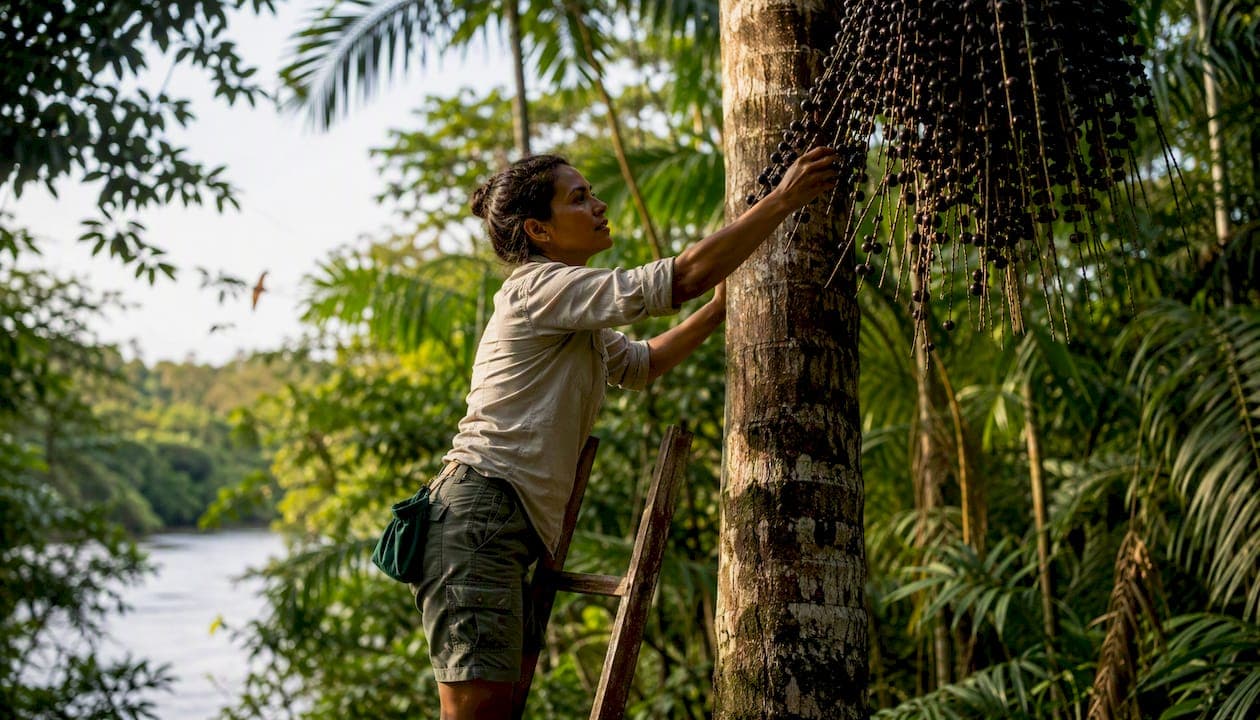
Açaí comes from Euterpe oleracea, a palm tree native to the eastern Amazon basin, with the Brazilian state of Pará at the heart of its range. Pará alone produced a very large majority of Brazil’s açaí in recent years, dominating national output. Long before it appeared in UK smoothie bowls, açaí was a daily calorie staple for ribeirinho (riverside) and indigenous communities across the Amazon estuary. Grovefoods sources frozen açaí pulp directly from this region, making the origin story more than cultural background — it is the supply chain.
Table of Contents
- Where does açaí grow? Botanical identity and native range
- What does the word açaí actually mean?
- How has açaí traditionally been prepared and eaten?
- How is açaí cultivated and harvested in Brazil?
- When did açaí go from regional staple to global commodity?
- Sustainability and responsible sourcing: what you need to know
- How does açaí reach UK buyers, and what should you check?
- How açaí gets from Brazil to the UK: the supply chain
- Key takeaways
- Why the origin story matters more than the superfood label
- Grovefoods: authentic frozen açaí for UK businesses and consumers
- Useful sources
Where does açaí grow? Botanical identity and native range
Euterpe oleracea belongs to the family Arecaceae, the palm family, and is the species behind virtually all commercial açaí fruit. It grows as a multi-stemmed clump rather than a single trunk, which matters practically: harvesters can cut one stem without killing the plant, and the clump continues fruiting for decades.
Its natural habitat is the seasonally flooded várzea and igapó forests of the eastern Amazon basin. The palm thrives in waterlogged soils along river margins, tidal channels and estuarine floodplains, conditions that most crops cannot tolerate. Pará state, and particularly the Marajó archipelago and the estuary around Belém, holds the densest wild and managed populations.
Key botanical facts at a glance:
- Species: Euterpe oleracea Mart. (family Arecaceae)
- Growth habit: multi-stemmed clump, reaching 15–30 metres in height
- Fruit: small, dark purple drupes roughly 1–2 cm in diameter, each with a single large seed
- Fruiting yield: each palm produces approximately 4–8 fruit bunches annually, with individual bunches weighing around 1.4–2.7 kg
- Native range: eastern Amazon basin, concentrated in Pará, Amapá and Maranhão states
A related species, Euterpe precatoria, grows across western Amazonia but as a solitary-stemmed palm. That structural difference has real conservation consequences: cutting the single stem of E. precatoria for heart-of-palm kills the plant outright, making it far more vulnerable to overharvest than its multi-stemmed eastern cousin.
What does the word açaí actually mean?
The name traces back to the Nheengatu and Tupi languages spoken across the Amazon basin long before Portuguese colonisation. The term derives from the indigenous word often rendered as asai or ïwasa'i, with a common folk etymology translating it as "fruit that cries" — a reference to the liquid released when the berries are soaked and crushed. Whether or not that etymology is strictly accurate linguistically, it captures something true about the fruit: the pulp is extracted through water and pressure, almost like wringing it out.
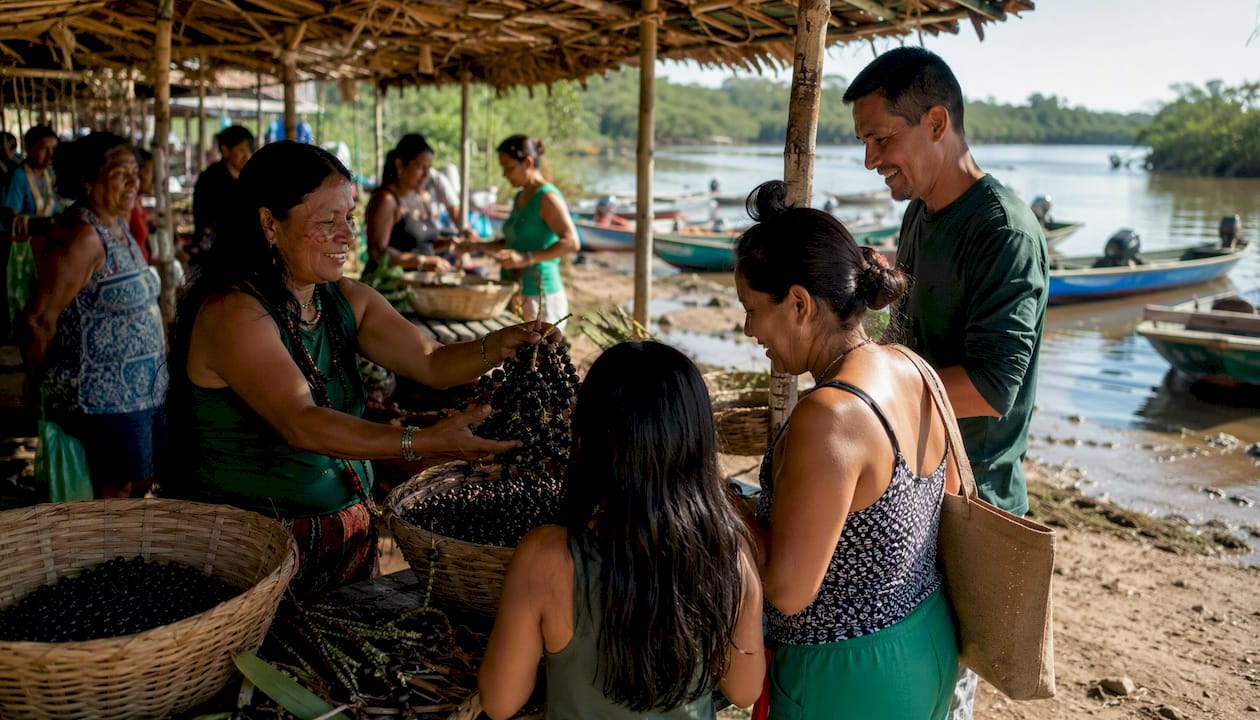
Archaeological and ethnographic evidence places açaí consumption in the Amazon estuary across many centuries. Ribeirinho and indigenous communities did not treat it as a seasonal treat but as a dietary foundation, consumed daily alongside fish, manioc flour and river shrimp. Ethnographic studies describe the açaí palm as a "tree of life" with at least twenty-five documented local uses in the estuary-delta region, spanning food, medicine, construction material and ritual.
The palm also functions as a cultural metonym for place and identity. Local songs, festivals and crafts in Pará reference it directly. In Belém, the state capital, açaí is a familiar and essential part of daily life.
How has açaí traditionally been prepared and eaten?
Traditional Amazonian preparation bears little resemblance to the sweetened smoothie bowls sold in London cafés. The process begins with soaking the berries in warm water to soften the thin layer of pulp around the seed, then crushing them against a sieve or basket to separate pulp from seed. Before mechanisation, this was done by hand by women known as amassadeiras.
The resulting pulp is thick, earthy and slightly bitter, with a flavour closer to unsweetened dark chocolate mixed with forest floor than anything tropical. It is consumed in several traditional forms:
- Açaí grosso (thick pulp): eaten as a porridge alongside dried or salted fish and manioc flour (farinha), forming a complete, calorie-dense meal
- Açaí fino (thin pulp): diluted with water and drunk as a beverage, often the first thing consumed in the morning
- Açaí com peixe: the thick pulp served as a side dish with grilled or fried river fish, a combination still common in Pará households
- Açaí com camarão: paired with dried shrimp, particularly in coastal communities
The contrast with the global format is stark:
| Feature | Traditional Amazonian | Global 'superfood' bowl |
|---|---|---|
| Sweetener | None | Honey, banana, granola |
| Consistency | Thick savoury porridge or thin drink | Frozen, blended, dessert-like |
| Accompaniment | Fish, manioc flour, shrimp | Fruit, seeds, nut butter |
| Primary role | Daily calorie staple | Occasional health food |
| Flavour profile | Earthy, slightly bitter | Sweet, mild |
Neither version is more authentic than the other in an absolute sense. The Amazonian version reflects scarcity and necessity; the global version reflects abundance and marketing. Both start from the same berry.
How is açaí cultivated and harvested in Brazil?
Most açaí is not grown on plantations. It is managed within existing floodplain forest systems, a practice that sits closer to selective forestry than conventional agriculture. Smallholders and extractivist family units thin competing vegetation, manage clump density and harvest fruit without clearing the forest canopy. IBGE data confirms that a high proportion of açaí production comes from family production and extractivist units rather than large agribusiness operations.
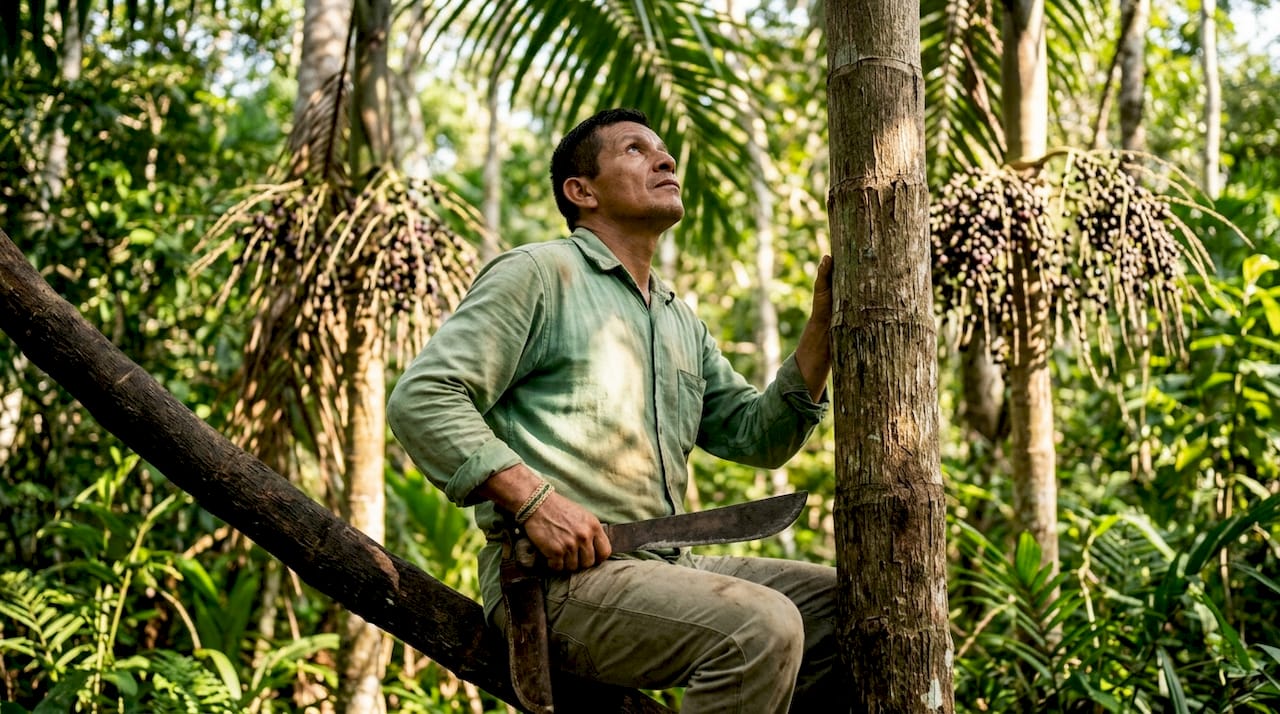
Harvesting requires climbing. A harvester ties a loop of rope or palm fibre around their ankles and shins, then walks up the palm stem in a technique called peconha. At the top, they cut the fruit bunches with a machete and lower them by rope. It is skilled, physically demanding work, and the seasonal rhythm shapes everything.
Açaí harvests follow two peak periods tied to Amazonian rainfall and tidal flooding: a primary peak from March to June and a secondary peak from August to October. Supply tightens outside these windows, which importers and UK buyers need to factor into their ordering.
| Metric | Figure | Source |
|---|---|---|
| Pará production | Over 1.2 million tonnes | IBGE |
| Pará share of national total | ~95% | IBGE |
| Production structure | Predominantly family/extractivist units | IBGE |
| Primary harvest peak | March–June | FAO |
| Secondary harvest peak | August–October | FAO |
Mechanised pulping, introduced in the late 1960s, transformed the economics of production. Before that, the amassadeiras processed berries by hand, limiting output to what local communities could consume. Machines multiplied throughput and made urban distribution viable at scale.
When did açaí go from regional staple to global commodity?
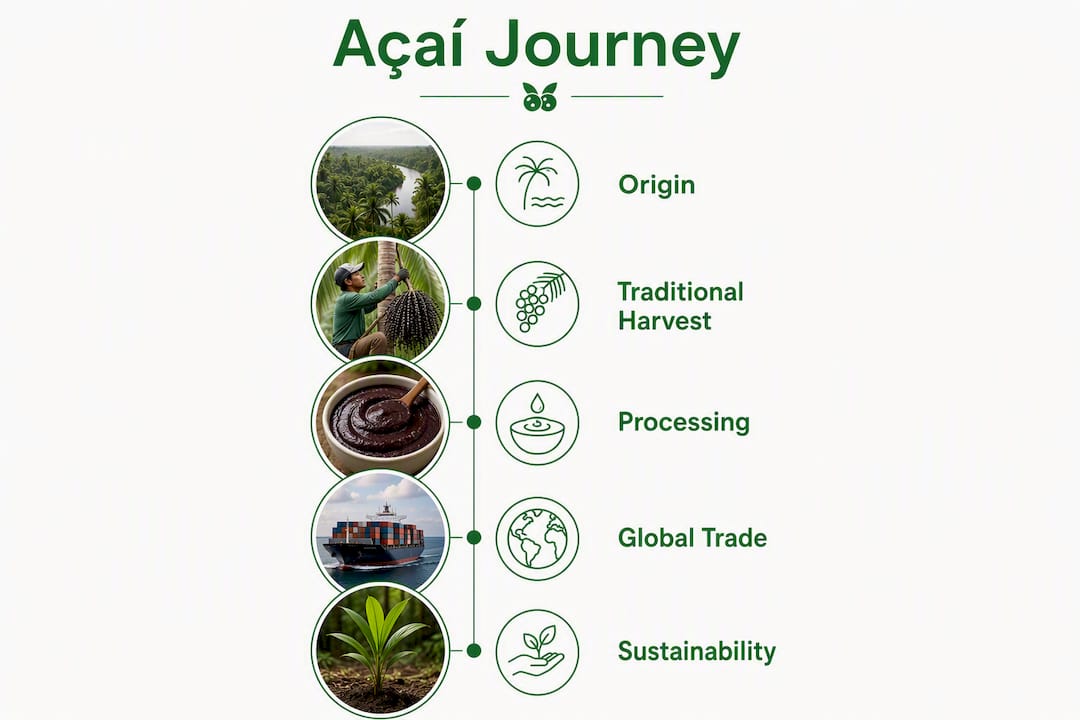
The journey from Amazonian riverbank to UK café counter unfolded in distinct stages:
- Pre-1960s: Açaí consumed almost entirely within the Amazon estuary region; hand-pulped by amassadeiras and sold fresh in local markets; shelf life of hours, not days
- Late 1960s: Mechanised pulping machines introduced, dramatically increasing production capacity and enabling distribution beyond immediate harvest areas
- 1970s–1980s: Internal migration carried Amazonian food habits to Brazil's southern cities; açaí shops (açaizeiros) appeared in Rio de Janeiro and São Paulo, initially serving the migrant community
- 1990s onward: Brazilian jiu-jitsu athletes and health networks promoted açaí as an energy food; the 'superfood' narrative took hold; frozen pulp technology enabled international export
- 2000s–2010s: Açaí bowls entered North American and European markets; celebrity endorsements and social media accelerated demand; Brazil's export volumes grew substantially
- Present: Açaí is a mainstream health food globally, though Belém and Pará remain the consumption heartland, with daily per-capita consumption far exceeding anywhere else on earth
The technology that made this possible was frozen pulp. Pasteurised and blast-frozen within hours of harvest, açaí pulp retains most of its nutritional profile and can be shipped internationally without the fruit degrading. That single processing step is what connects a smallholder in the Marajó archipelago to a café in Manchester.
Sustainability and responsible sourcing: what you need to know
The ecological picture is not uniformly positive. Rapid demand growth has created pressure on floodplain forests, and the distinction between E. oleracea and E. precatoria matters here. The solitary-stemmed western species is far more vulnerable to overharvest; removing it for heart-of-palm kills the plant permanently. Even with the more resilient E. oleracea, poorly managed extraction can degrade forest structure over time.
Açaí integrates well into agroforestry systems alongside native species such as cocoa and cupuaçu, which improves biodiversity and diversifies smallholder income. This approach, recommended by the FAO, looks less like farming and more like managed forest, which is precisely why it can be sustainable when done properly. The challenge is that global demand incentivises intensification, which can push producers away from mixed systems toward monoculture-style management.
Community-level responses include ethnomapping, where traditional ecological knowledge is used to identify sustainable harvest zones and avoid overharvesting pressure points. NGOs and some local institutions support these programmes, though coverage is uneven.
Pro Tip: When buying açaí in the UK, ask suppliers whether their product comes from agroforestry-managed sources or certified extractivist communities. A supplier who cannot answer that question probably cannot trace their supply chain back to the farm.
What responsible sourcing looks like in practice:
- Traceability documentation linking the product to a named region or cooperative
- Certification from recognised bodies (organic, Rainforest Alliance, or equivalent)
- Frozen-on or frozen-shortly-after-harvest dates on packaging
- Supplier transparency about whether production is family/extractivist or large-scale industrial
- Preference for multi-stemmed E. oleracea sourcing over heart-of-palm operations
How does açaí reach UK buyers, and what should you check?
Frozen açaí pulp arrives in the UK almost exclusively as blast-frozen product, typically in 100g portion packs or larger bulk formats for foodservice. Fresh açaí berries are not commercially viable for export: the fruit degrades within 24 hours of harvest, making frozen pulp the only practical format for international trade.
UK buyers should look for:
- Origin labelling: the product should state Pará or the Brazilian Amazon specifically, not just "Brazil"
- Frozen-on date: ideally frozen within hours of harvest; this is the single strongest indicator of quality
- Certifications: Halal, Kosher, organic, and gluten-free status matter for foodservice buyers serving diverse customers
- Pulp grade: commercial açaí comes in different grades (A, B, C) based on pulp-to-water ratio; grade A has the highest açaí content
- No added sugar: traditional and premium products contain only açaí; sweetened blends are a different product category
The difference between frozen açaí sourced directly from Pará producers and generic imported pulp is detectable in flavour and colour. Authentic product is deep purple-black with an earthy, slightly astringent taste. Pale, mild, or overly sweet pulp usually indicates dilution or lower-grade processing.
For UK foodservice buyers, wholesale frozen açaí needs to be ordered with harvest seasonality in mind. The March–June primary peak is when the freshest product enters the supply chain; ordering ahead of this window and holding frozen stock is standard practice for buyers who want consistent quality year-round.
How açaí gets from Brazil to the UK: the supply chain
The journey from an Amazonian floodplain to a UK kitchen involves several distinct stages, each of which affects quality and traceability.
Harvest and initial processing: Fruit bunches are cut by hand, transported by boat along river channels to processing facilities, and pulped within hours. Speed is critical because açaí degrades rapidly at ambient temperature. Pulp is pasteurised, portioned and blast-frozen at the processing facility.
Domestic logistics in Brazil: Frozen pulp moves from Pará processing facilities to export hubs, primarily through Belém or Manaus, via refrigerated road transport. Cold chain integrity at this stage is non-negotiable; any break in the freeze compromises the product.
Export and shipping: Açaí leaves Brazil as frozen cargo in refrigerated containers (reefer containers) maintained at around -18°C. Transit time from Brazilian ports to UK ports typically runs several weeks, depending on routing and shipping schedules.
UK import and customs: Frozen food imports into the UK require compliance with UK food safety regulations, including documentation of origin, processing standards and cold chain records. Importers must register with the relevant UK authorities and meet labelling requirements under UK food law.
Distribution within the UK: Once cleared through customs and UK port health authorities, product moves to cold storage facilities and then to distributors, wholesalers or direct to foodservice and retail customers. UK retailers sourcing frozen Brazilian products typically work with specialist distributors who manage the import compliance and cold chain logistics end-to-end.
The entire chain, from harvest in Pará to a café in Birmingham, can take six to ten weeks. That timeline underlines why frozen-on dates matter: a product frozen in March and delivered in May is still high-quality; one that sat in ambient conditions before freezing is not.
Key takeaways
Açaí (Euterpe oleracea) is native to the eastern Amazon basin, with Pará state producing roughly 95% of Brazil's total output and smallholder family units forming the backbone of that supply.
| Point | Details |
|---|---|
| Species and origin | Euterpe oleracea, native to eastern Amazon floodplains; Pará is the dominant production state |
| Production scale | Pará produced over 1.2 million tonnes in 2019, roughly 95% of Brazil's national total |
| Cultural role | A daily dietary staple for ribeirinho and indigenous communities for centuries, not a modern health trend |
| Harvest seasonality | Primary peak March–June; secondary peak August–October; UK buyers should plan orders around these windows |
| UK sourcing checks | Prioritise frozen-on dates, Pará origin labelling, grade A pulp, and supplier traceability documentation |
| Grovefoods supply | Grovefoods sources frozen açaí directly from the Amazon for UK foodservice and retail buyers, with Halal, Kosher and gluten-free certifications |
Why the origin story matters more than the superfood label
The global açaí market has a habit of stripping the fruit of its context. By the time it reaches a UK menu, it is usually described in terms of antioxidants and ORAC scores, with no mention of the ribeirinho families who harvested it or the floodplain forest it came from. That is not just a cultural omission; it has practical consequences for quality and sustainability.
When origin is invisible, buyers cannot distinguish between responsibly managed extractivist production and industrial-scale operations that are degrading the very ecosystems açaí depends on. The "superfood" framing encourages consumers to think about what the product does for them nutritionally, rather than what the supply chain does to the communities and forests that produce it.
The açaí palm has been sustaining people in the Amazon for centuries without any help from global wellness trends. What it needs from the international market is not enthusiasm but accountability: traceability, fair pricing back to smallholders, and sourcing decisions that reward producers who manage their forests well. The origin story is not background colour. It is the quality signal.
Grovefoods: authentic frozen açaí for UK businesses and consumers
UK buyers who want açaí that genuinely traces back to Pará smallholders have a straightforward option. Grovefoods supplies premium frozen açaí sourced directly from the Brazilian Amazon, available in formats suited to cafés, restaurants, hotels, retailers and individual consumers across the UK.
Every product carries Halal and Kosher certification, is naturally gluten-free, and arrives blast-frozen to preserve the flavour and nutritional profile that makes authentic Pará açaí worth sourcing in the first place. For trade buyers, wholesale pricing and bulk formats are available through the foodservice channel, with online ordering for direct delivery to individuals. If you are building a menu around genuine Brazilian flavours or stocking a retail range that can honestly claim Amazon provenance, contact Grovefoods to discuss your requirements.
Useful sources
Further reading and primary references used in this article:
- The Global Açaí: A Chronicle of Possibilities and Predicaments of an Amazonian Superfood — the most thorough academic account of açaí's cultural history, commercialisation timeline and ethnographic significance; essential for anyone researching the origin story in depth
- Instituto Brasileiro de Geografia e Estatística (IBGE) — Brazil's national statistics institute; primary source for production volumes, regional breakdowns and producer unit data
- Food and Agriculture Organization of the United Nations (FAO) — covers agroforestry integration, harvest seasonality and species management guidance for Euterpe oleracea and E. precatoria
- National Center for Complementary and Integrative Health (NCCIH) — Açaí — US National Institutes of Health overview of the açaí palm's native range, traditional uses and safety profile
- HerbalGram — Açaí herb profile — detailed botanical profile including fruiting data, yield figures and phytochemical background
- Açaí palm — Wikipedia — useful rapid reference for taxonomy, etymology and geographic distribution, with links to primary botanical sources
- Going.com — The rise of açaí bowls — accessible account of Belém's consumption culture and the spread of açaí into global markets